News Story
Gut Monitoring "Smart Pill" Testing Advances
University of Maryland (UMD) researchers are making progress on ingestible capsule technology designed to make gastrointestinal (GI) disease diagnosis less invasive and more accessible. From step forwards in testing to new mechanisms, the gut monitoring “smart pill” is now closer to providing an alternative to invasive techniques like endoscopies when monitoring gut health by autonomously detecting early signs of disease and monitoring tissue health.
“These advancements represent an important step toward autonomous ingestible biopsy systems that could one day reduce the need for conventional endoscopic biopsies,” said UMD Distinguished University Professor Reza Ghodssi. “The work highlights how advances in microsystems engineering and additive manufacturing can unlock new capabilities for biomedical devices. We're excited about the potential for smart ingestible technologies to transform the diagnosis and monitoring of GI diseases.”
Advancements in Testing
Inflammatory bowel diseases (IBDs), such as Crohn’s disease and ulcerative colitis, are among the most prevalent GI disorders. Traditional endoscopies allow diagnosis through visualization but are highly invasive and only effective when symptoms worsen.
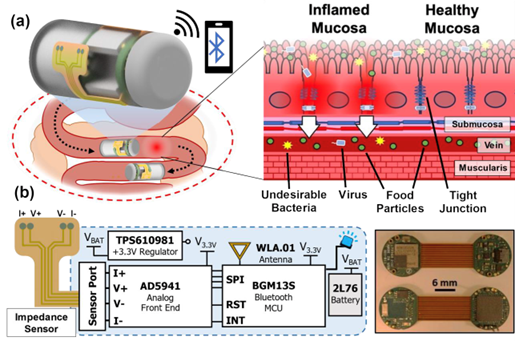
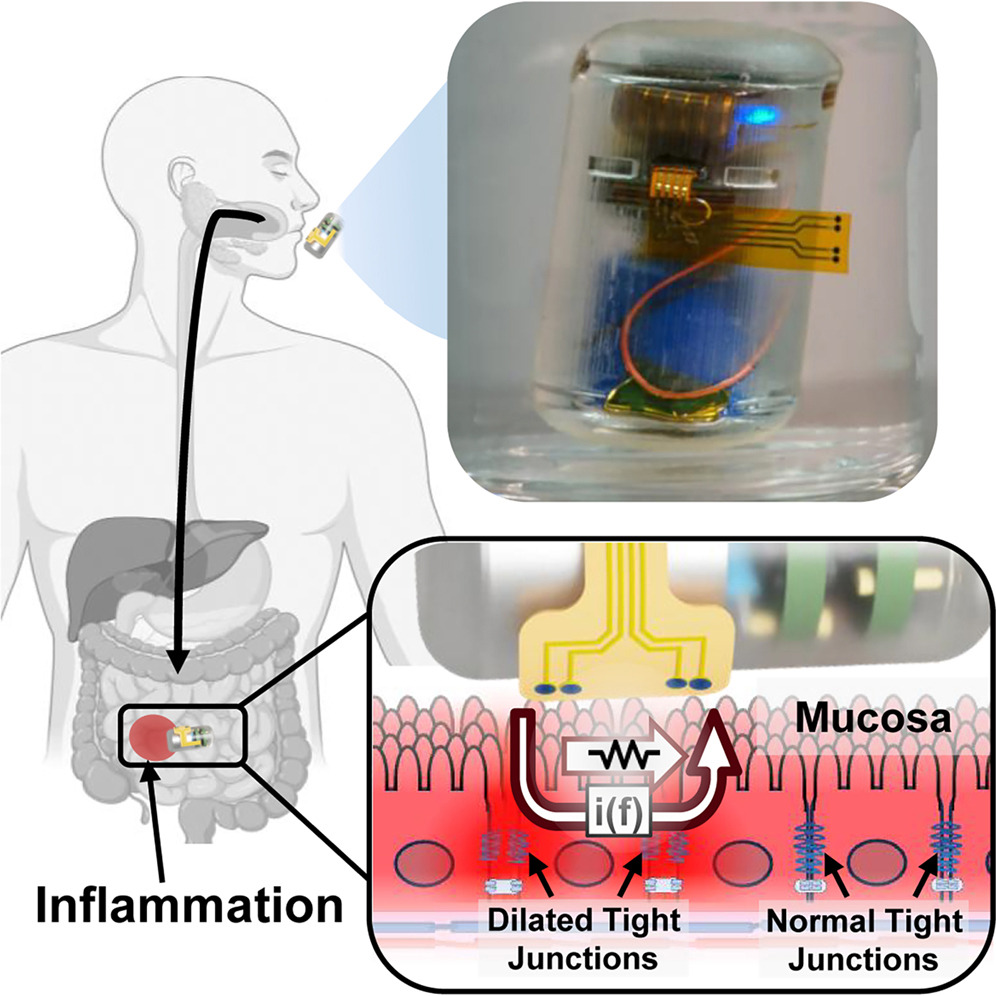 “In vivo monitoring of tissue permeability in a rat colitis model via a bioimpedance-sensing ingestible device” outlines new data that shows GI inflammation can be detected using bioimpedance, a measure of how easily ions pass through intestinal tissue. Capsules can wirelessly monitor this permeability, providing a noninvasive path toward diagnosis. The paper is available to read online through Cell Press’ Device journal.
It was written by Mateo W. Lim (ECE/ISR/Fischell Institute), Hammed Ayansola (Animal & Avian Sciences), Justin M. Stine (MATRIX Lab), Julie M. Karasik (BIOE), Younggeon Jin (Animal & Avian Sciences), and Reza Ghodssi (ECE/ISR/Fischell Institute/MATRIX Lab).
“I'm very excited to have completed my first journal publication. I believe our group is making important strides towards noninvasive detection of gut inflammation,” said Lim. “This technology has promising applications for autonomous health monitoring and drug delivery. It integrates aspects of additive manufacturing, electronics, and sensor design to create a system.”
The paper also outlines capsule advancements, which include improved packaging suitable for in vivo GI environment. Researchers utilize UV resin to fill holes between components and seal everything together. Next steps include refining capsule prototypes for real-world use, as the capsule is in development and not currently available to the medical community.
Power Efficient Tissue Sampling
Biopsies remove pieces of tissue so they can be tested in a lab for abnormalities and are traditionally done by doctors. UMD researchers are working toward a capsule that can autonomously perform this process. Previously developed systems struggled to collect meaningful tissue samples and operate from a tiny capsule battery.
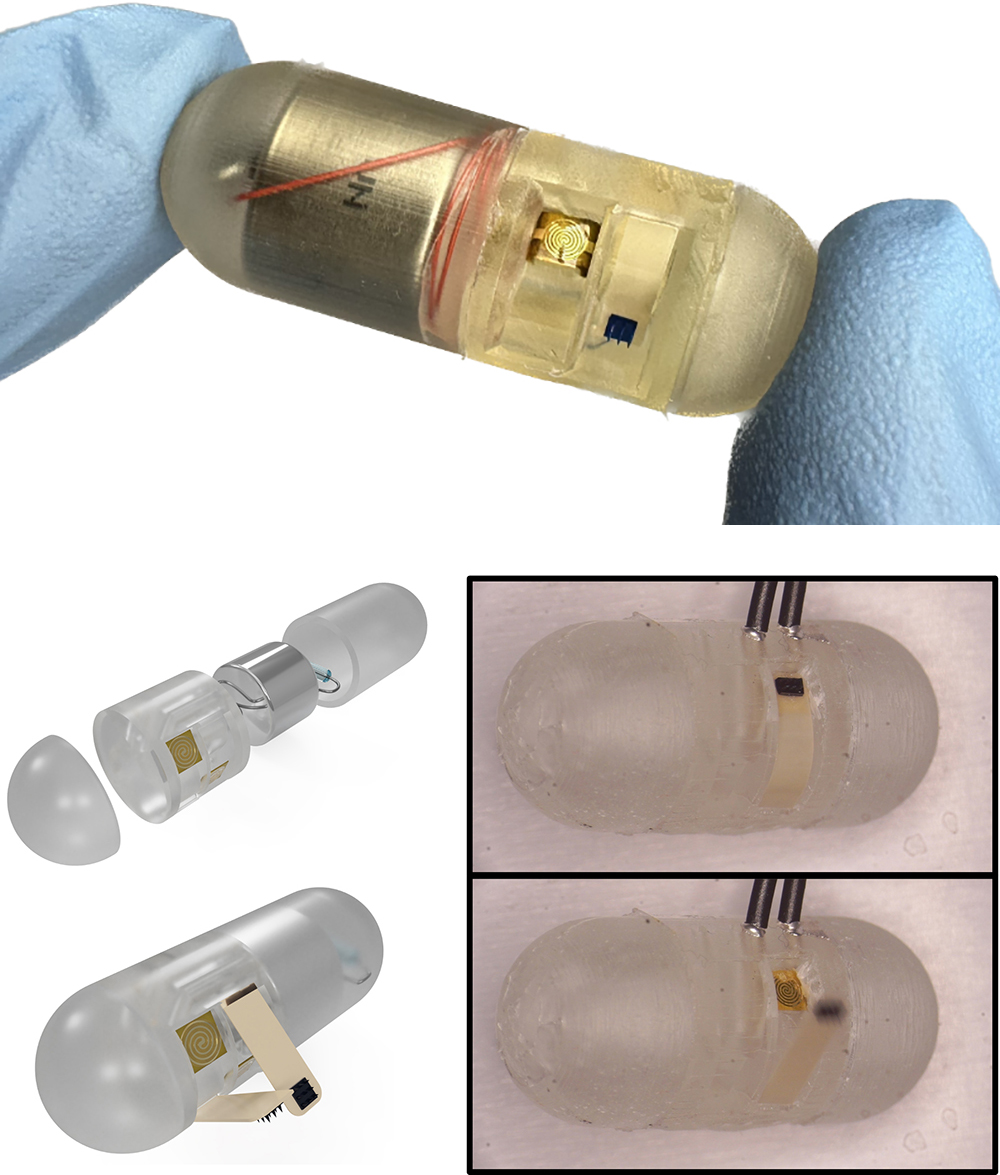
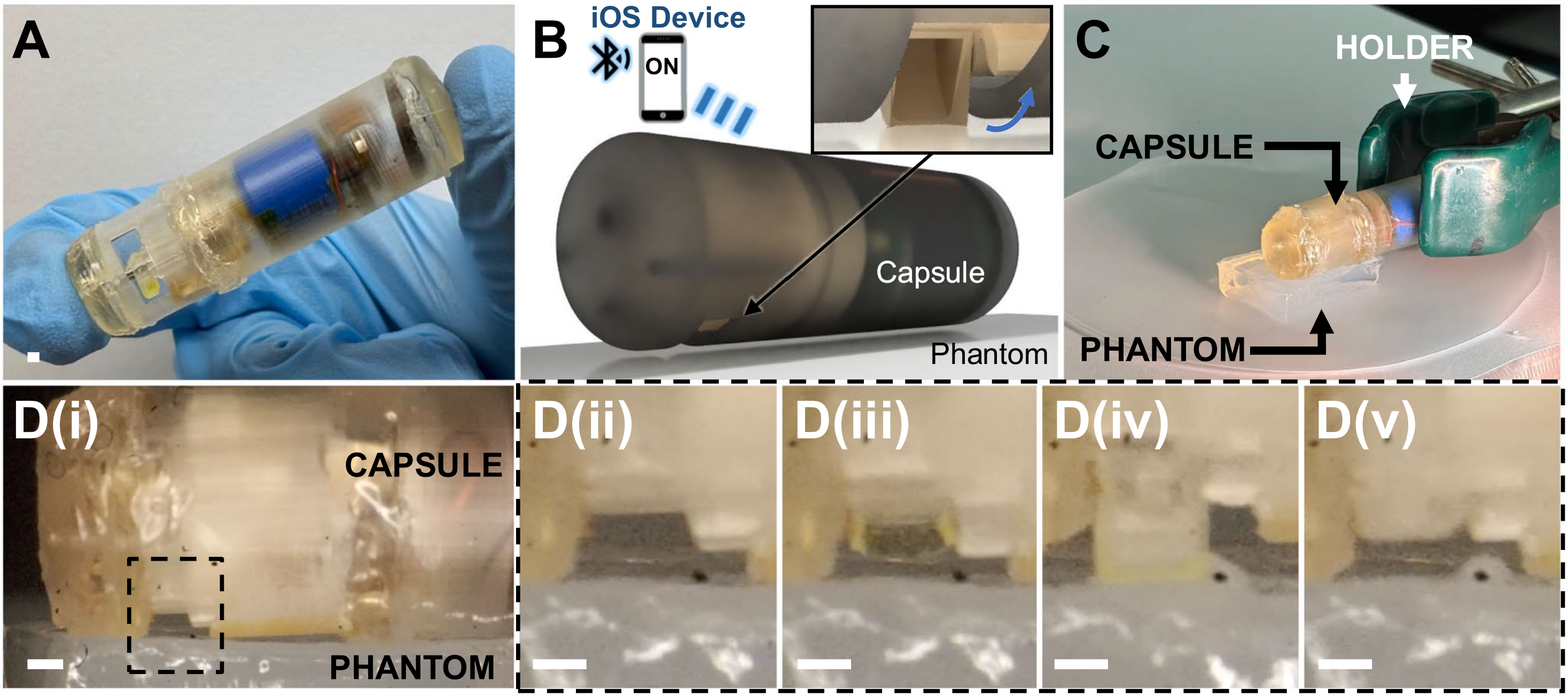 To address that issue, the UMD team developed an advanced capsule that uses less power. The battery only needs enough energy to heat an adhesive. When the adhesive melts, a spring is released - causing the capsule’s gears to move. This launches the hybrid 3D-printed tissue scraper, which gathers the sample. The innovative scraper was made with a combination of conventional resin 3D printing and two-photon direct laser writing, a more advanced manufacturing process that is extraordinarily precise.
The work is outlined in “Gear-Train Enabled Ingestible Capsule System Toward Wireless Targeted Intestinal Biopsy,” which is now available to read online through IEEE’s Journal of Microelectromechanical Systems. The paper’s authors include Michael A. Straker (BIOE/ISR/Fischell Institute), Joshua A. Levy (MSE/ISR/Fischell Institute), Anika Prasanna (BIOE), Patrick A. Sweeney (ECE), Justin M. Stine (ISR/MATRIX Lab), Luke A. Beardslee (ISR), and Reza Ghodssi (BIOE/ISR/Fischell Institute/MSE/ECE/MATRIX Lab).
“The invasive and expensive nature of the currently available clinical tools are a significant limiting factor in GI disease monitoring,” said Straker. “GI biopsy can be an intense process for patients and must be conducted by highly skilled medical professionals. That's why I'm excited about the results of this work. We are inching closer to a world where these monitoring devices can be more accessible, taken more regularly, and hopefully help facilitate early disease detection and prevention.”
Researchers demonstrated that the device reliably collects samples and gathers a higher volume than their previous design while reducing power consumption by up to 80% compared with previous prototypes. The team ultimately envisions a fully autonomous ingestible capsule capable of locating diseased tissue on its own.
Published August 10, 2026
Related Stories
Stories / February 20, 2026
University of Maryland Research is Redefining Health Care

Stories / April 7, 2025
Research Paper and Cover Art Now Feature Article in Journal

Stories / February 11, 2025
Ingestible Capsule Advances May Lead to Earlier Detection of...
Stories / July 2, 2024
New features on ingestible capsule will deliver targeted drugs...
Stories / March 14, 2024
Clark School Research Nominated for “Invention of the Year”
Stories / February 19, 2024
Ingestible Capsule Technology Research on Front Cover of Journal
Stories / December 14, 2023
Gut Health Monitoring Gas Sensors Added to Ingestible Capsule...
Stories / March 31, 2026
NIH Funds "Smart Pill" for Gut Health Monitoring

Stories / June 26, 2025
Adjustable Drug Release Marks New Milestone in Ingestible...
Stories / February 26, 2025
Sydney Overton receives Graduate School’s Outstanding...